
1. Introduction to Vehicle Security and the Advent of Immobilisers
In the ever-evolving landscape of automotive technology, the development of car immobilisers marks a significant milestone. An immobiliser is an electronic security device in motor vehicles that prevents the engine from starting without the correct key transponder ID. These sophisticated systems, designed to prevent unauthorised vehicle use, emerged in response to escalating car theft rates. Early forms of vehicle security were rudimentary, relying on physical barriers such as steering locks. However, as car theft techniques became more advanced, the need for a more robust and technologically driven solution became evident, leading to the birth of immobilisers.
2. The Genesis of Immobiliser Technology in the 20th Century
The concept of the car immobiliser can be traced back to the early 20th century. The electric immobiliser/alarm system was invented in 1919 by St. George Evans and Edward Birkenbuel, but it wasn't until the 1970s and 1980s that the technology began to take a recognisable form. Early iterations were simple, often utilising magnetic key systems that interacted with a vehicle's ignition. This rudimentary approach laid the groundwork for more sophisticated systems, setting the stage for a revolution in car security.
3. The Immobiliser Renaissance: A Leap in Electronic Security
The 1990s witnessed a significant leap in immobiliser technology. Electronic immobilisers using transponder chips embedded in car keys became widespread and were required on new cars in the UK from 1998. These chips communicate with the vehicle’s immobiliser system, allowing the engine to start only when the key is authorised. On conventional bladed keys, a coil around the ignition energises the passive transponder; the precise authentication process depends on the vehicle. This era marked a significant departure from mechanical locking systems, introducing a new paradigm in vehicle security.
4. The 21st Century: Smart Immobilisers and Integrated Systems
As the new millennium unfolded, car immobilisers evolved into sophisticated systems integrated with a vehicle's onboard computer. Smart immobilisers came into play, offering features like remote locking and alarm systems that communicated with the immobiliser. Early models used a static code in the key, while later models used rolling codes or advanced cryptography. These advancements not only enhanced security but also offered convenience to users, showcasing a harmonious blend of safety and user-friendliness.
5. The Influence of Digital Technology on Immobiliser Systems
The digital age has brought further advances in immobiliser technology. Encryption and challenge-response authentication make unauthorised key duplication more difficult, but no security system should be described as impossible to defeat. Incorrect programming attempts can trigger security delays or a no-start condition, depending on the vehicle. Connected alarms and tracking services may also provide monitoring, but those features are separate from the immobiliser and are not present on every car.
6. Contemporary Challenges and the Rise of Relay Attacks
Despite these advancements, car thieves continually adapt their methods. The latest challenge in vehicle security is the relay attack. Relay attacks are a type of car theft method targeting vehicles with keyless entry systems. In these attacks, thieves use electronic devices to relay signals from a car key located inside a house to a vehicle parked outside, effectively tricking the car into thinking the key is nearby. This allows the thieves to unlock and start the car without needing physical access to the key.
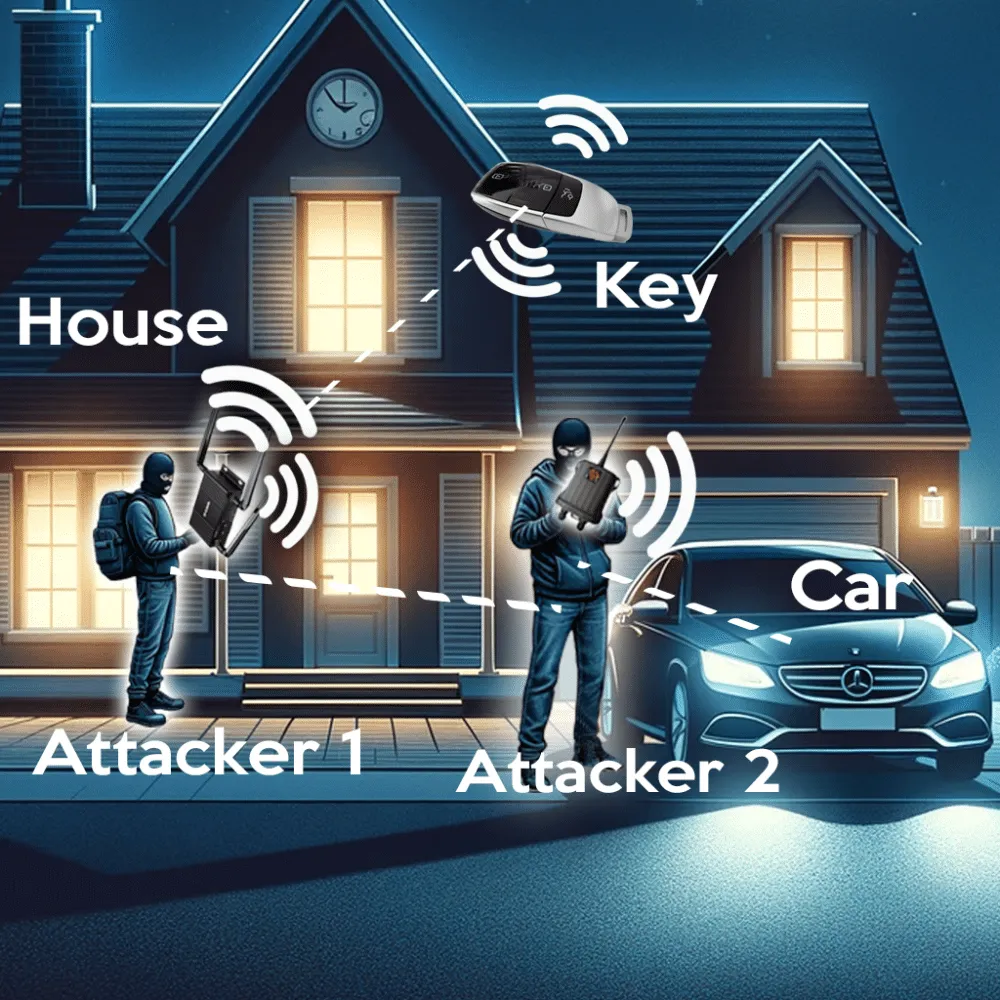
Relay attacks are a concern for some keyless entry systems. They highlight the need for additional security measures in car key technology. Manufacturers continue to develop protections, including motion-sensitive keys and newer methods of checking how close the key really is to the vehicle; availability varies by model.
Faraday boxes or pouches can reduce relay-attack risk by blocking the key’s signal, provided they work correctly and are checked regularly. Some vehicles allow passive keyless entry to be switched off. An additional immobiliser can provide a separate authorisation step, while a tracker may help locate a stolen vehicle. These measures serve different purposes and none guarantees theft prevention.
7. The Future of Immobilisers: Biometrics
Biometric systems, such as fingerprint or facial recognition, offer another way of identifying an authorised driver on some vehicles. They also raise ethical, privacy and personal-data questions. Their benefits depend on how they are implemented and how backup access is secured; they should not be treated as a foolproof replacement for every other security measure.
8. Environmental and Economic Impact of Advanced Immobilisers
The advancement of immobiliser technology has not only enhanced vehicle security but also had a positive impact on the environment and economy. By reducing car theft, these systems decrease the demand for new vehicles to replace stolen ones, and also environmental factors involved around stolen vehicles being crashed and abandoned and oftentimes set on fire damaging the surrounding ecosystems. Economically, they save insurance companies and car owners significant amounts in theft-related costs.
UK vehicle-theft figures fell substantially from their 1990s peak. Improved vehicle security, including immobilisers, contributed to that change, alongside other factors. A theft chart alone cannot show how much of a change is caused by one technology.

Vehicle theft remains a changing problem, and some keyless systems have created new opportunities for thieves. Historical figures should be read in the context of their reporting period: a forecast made for 2023 is not a current theft statistic. Reliable, dated crime data is needed before attributing any rise to a particular theft method.
9. Conclusion: The Journey of Immobiliser Technology and its Role in Modern Society
In conclusion, the journey of car immobiliser technology from simple mechanical devices to sophisticated electronic systems reflects the dynamic interplay of technological innovation, evolving security challenges, and societal needs. Today, immobilisers are not just theft-prevention devices but integral components of a vehicle's identity, offering a blend of security, convenience, and innovation. As we move forward, the continuous evolution of immobiliser technology will undoubtedly play a crucial role in shaping the landscape of automotive security.